The story
I just wanted
to publish books.
How being the human copy‑paste between two AIs turned into a tool for coordinated contradiction — one shared pen, one writer at a time.
It started with a book factory
I'd built a pipeline to help write and publish novels, almost end to end. But a single AI, left to itself, is just vibe coding — you ship more than you review. With no one to push back, it goes off the rails exactly like a developer who never gets a code review: it drifts, and nobody notices.
So I put two AIs to work together
One produces, the other challenges. That contradiction changed everything. The catch: to get a second opinion I was passing context from one AI to the other by hand. I had become the human copy‑paste — the message bus between two assistants blind to one another.
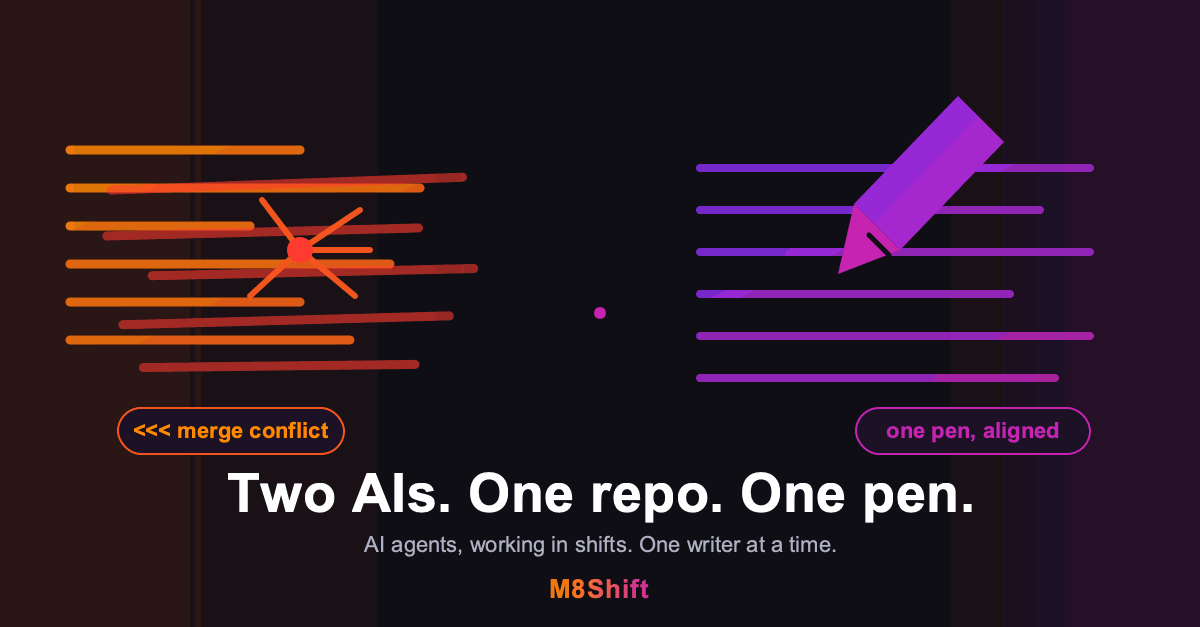
Two AIs, one repo — and the last save wins.
What was missing was a talking stick
Two agents writing to the same repository at the same time is a meeting where everyone talks at once: nobody is heard, and the last save overwrites the rest. The real answer fit in one word — a lock. Exactly one writer at a time.
One file, one shared pen
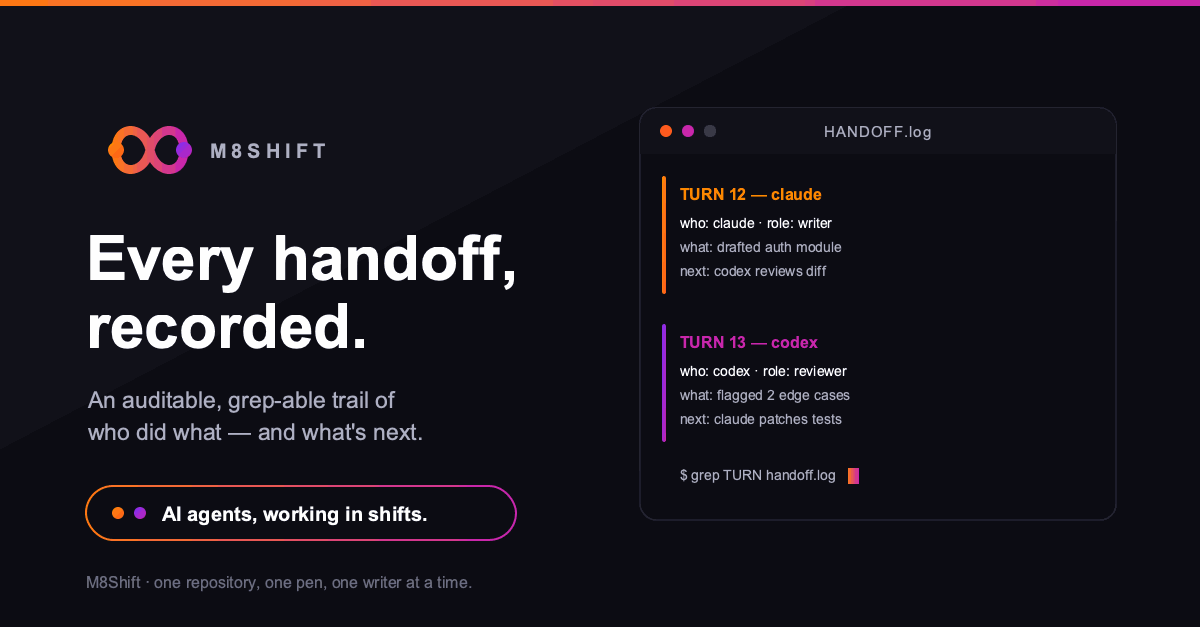
That lock is M8Shift. A single Python file you drop at the root of a project, and one shared “pen”: an agent must claim it before touching the code — otherwise it waits its turn. It works, records what it did and what it needs next, then hands the pen on. All the coordination lives in a file versioned with your code.
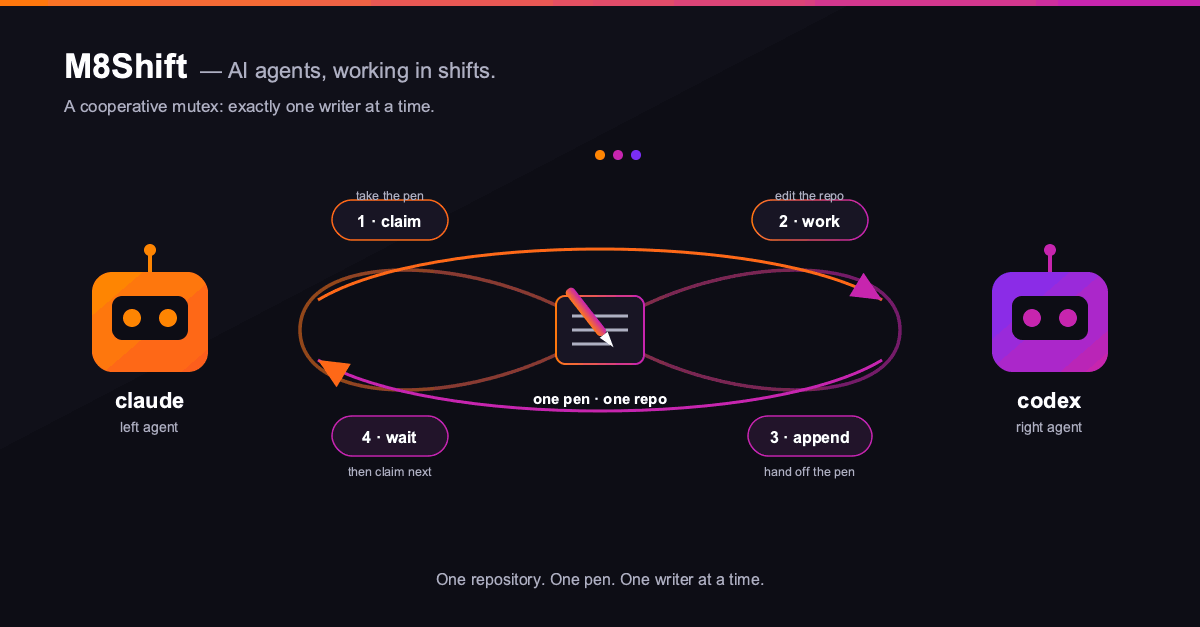
A small infrastructure for contradiction.
Not one agent replacing judgment
I never wanted to hand my judgment to an “AI team”, nor to a black‑box orchestrator deciding for me. I wanted several minds that don't think alike kept in the same loop — their disagreements made visible, instead of buried in separate chats.
M8Shift isn't a productivity hack. It's a way to keep multiple competent, evolving viewpoints in play without letting them overwrite each other.
The time, given back
Today two AIs work hand in hand for hours — one can wait more than an hour and a half for the other to finish, then pick up as if nothing happened. Producing, challenging, cross‑reviewing: real teamwork. And while it runs, I'm not in front of my screen.
Dogfooded by design
M8Shift is developed using M8Shift: one AI writes the code, another reviews it, and they hand off through the very pen they're building. The contradiction is the point — and it's all open source, under the Apache 2.0 license.
The AIs pass the pen. I keep the direction.
Coordinate your AI teammates
Free and open source. One file. No server, no API key.